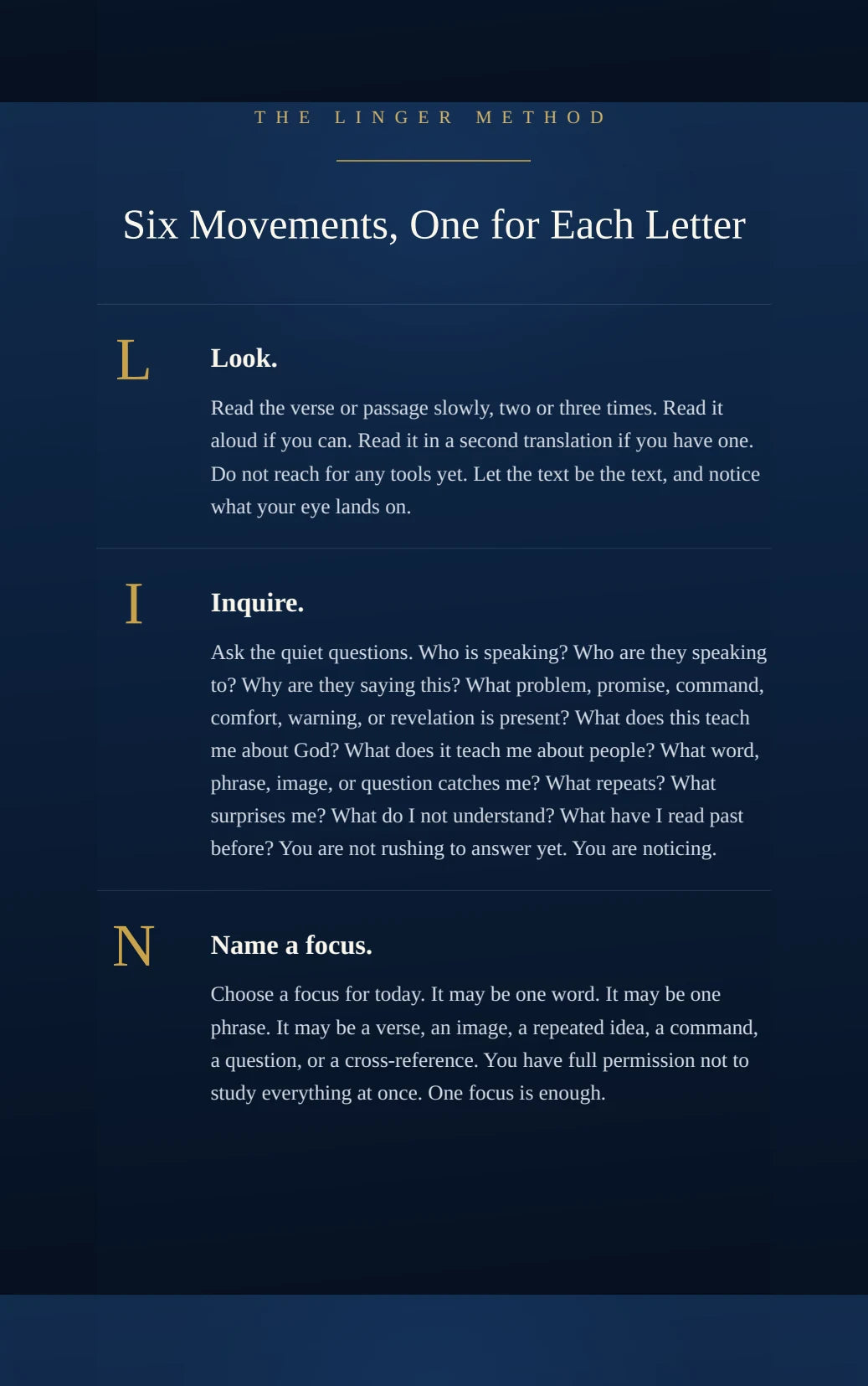
L — Look
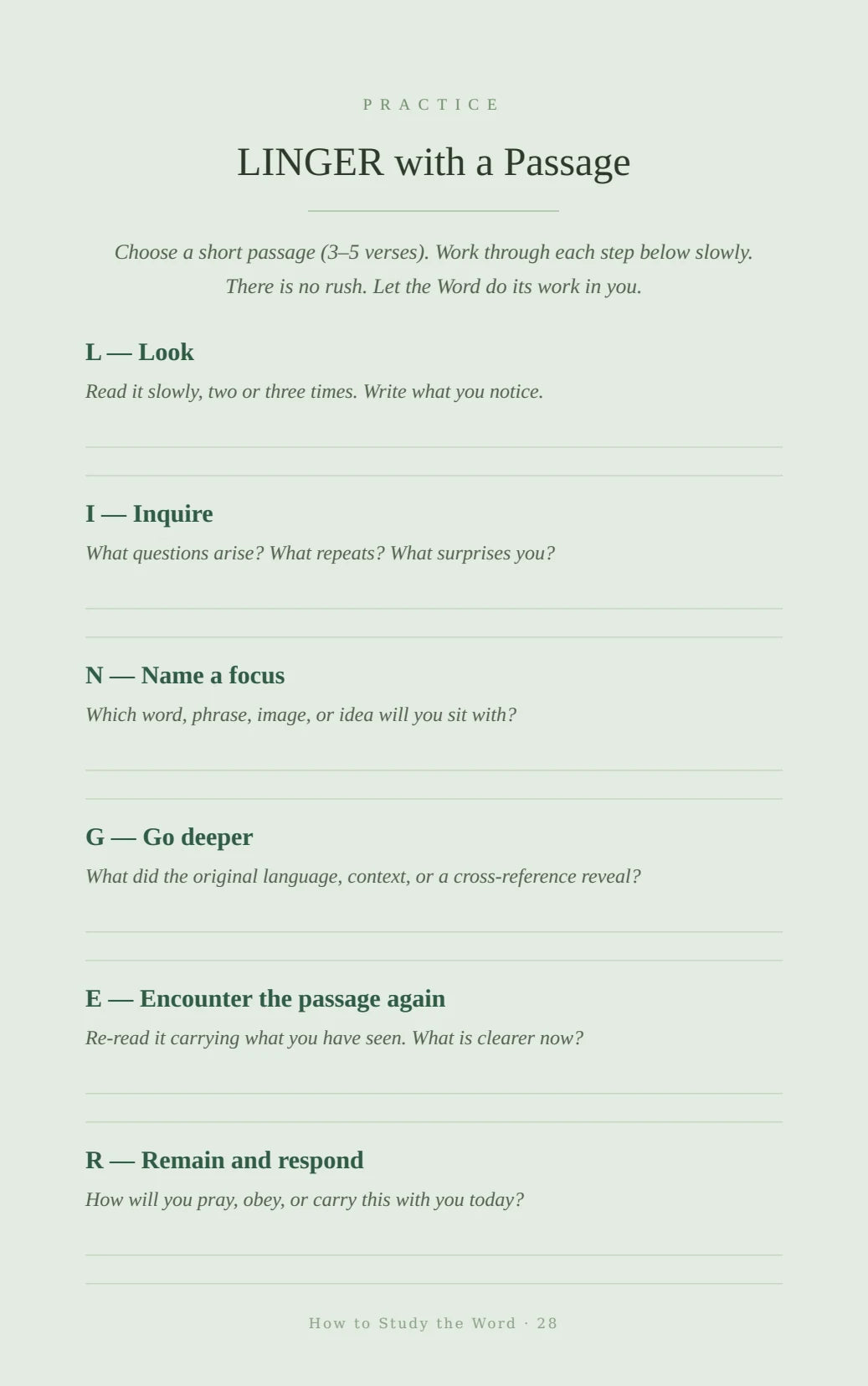
Read the verse or passage slowly two or three times. Notice what catches your attention before reaching for additional tools.
A FREE COMPANION GUIDE
Learning to Linger in the Scriptures
Learn a slower, prayerful way to approach Scripture—one that helps you stay with the Word long enough for it to shape you.
This free 29-page guide gives you a simple, repeatable rhythm for prayerful attention, meditation, original-language study, cross-referencing, obedience, and return.
Enter your first name, email address, and mobile number to receive the free 29-page guide.

ANOTHER WAY TO READ
Most people read the Bible and move on. Few people stop and wrestle with it.
Many of us were taught to cover a chapter, complete a plan, and move on. None of that is wrong. This guide introduces another way—older and slower: take a portion of Scripture, turn it over, pray through it, study it carefully, and let it open over time.
It is not a rejection of ordinary Bible reading. It is an additional practice of prayerful attention.
THE HEART OF THE GUIDE
This is not merely about collecting information. It is about coming to a Book that is alive—approaching the living Word expecting to know God and be formed by Him.
A HELPFUL RHYTHM FOR DEEP STUDY
To remain, unhurried, with what is in front of you. Six movements are available whenever they help; some days one movement is enough.
Read the verse or passage slowly two or three times. Notice what catches your attention before reaching for additional tools.
Ask quiet questions about context, repetition, surprise, meaning, what the passage reveals about God, and what you do not yet understand.
Choose one word, phrase, image, verse, command, question, theme, or repeated idea. You do not have to study everything at once.
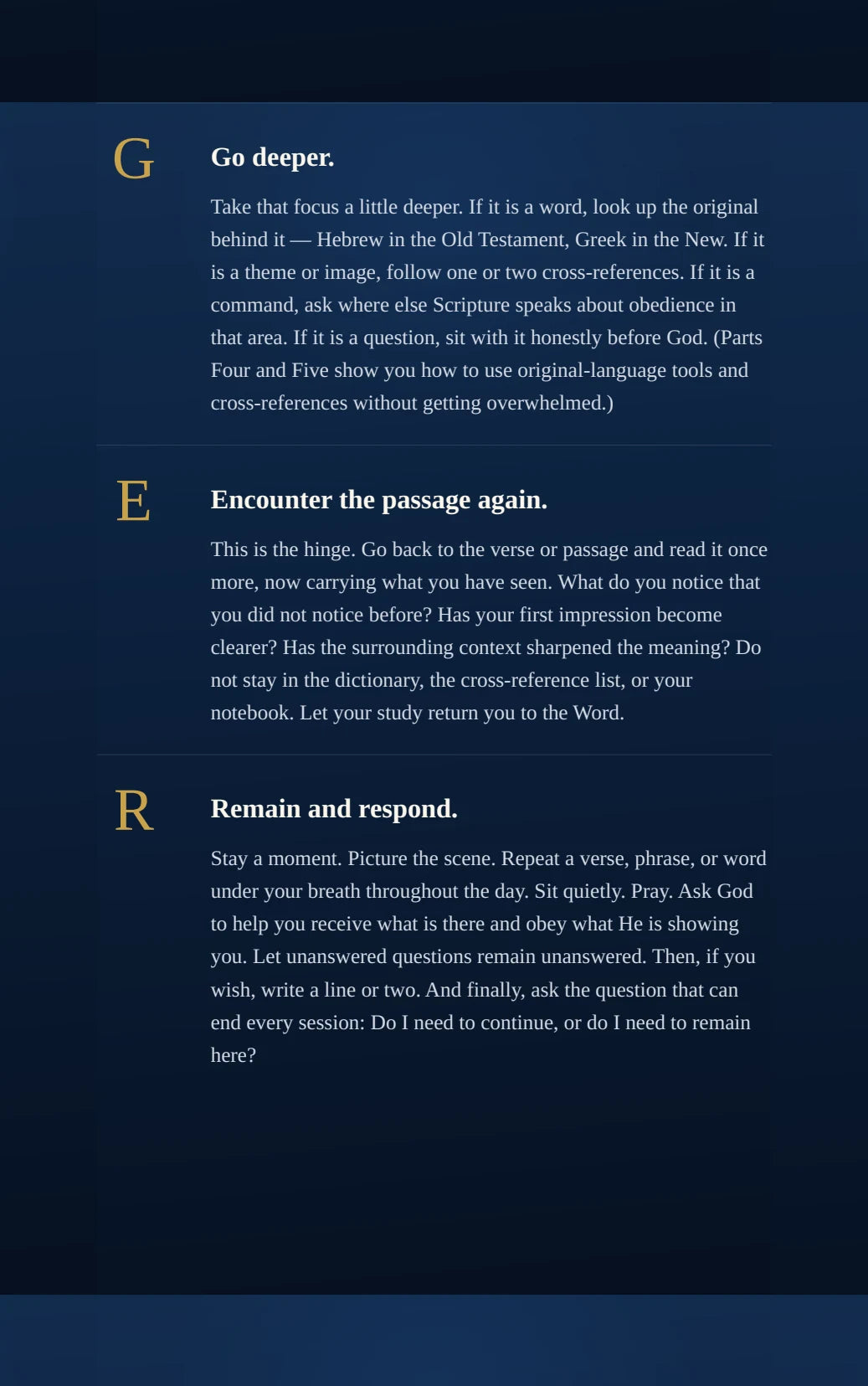
Use context, original-language tools, and one or two cross-references to explore that focus without becoming overwhelmed.
Return to the passage carrying what you have learned. Notice what has become clearer. Let your study return you to the Word.
Stay with the Word. Pray, obey, repeat, write, meditate, or simply remain before moving on.
INSIDE THE GUIDE
A grounded set of practices for moving from first attention to careful study—and always back to the passage itself.
Make the Holy Spirit the primary teacher, and approach the living Word with an open heart and attentive mind.
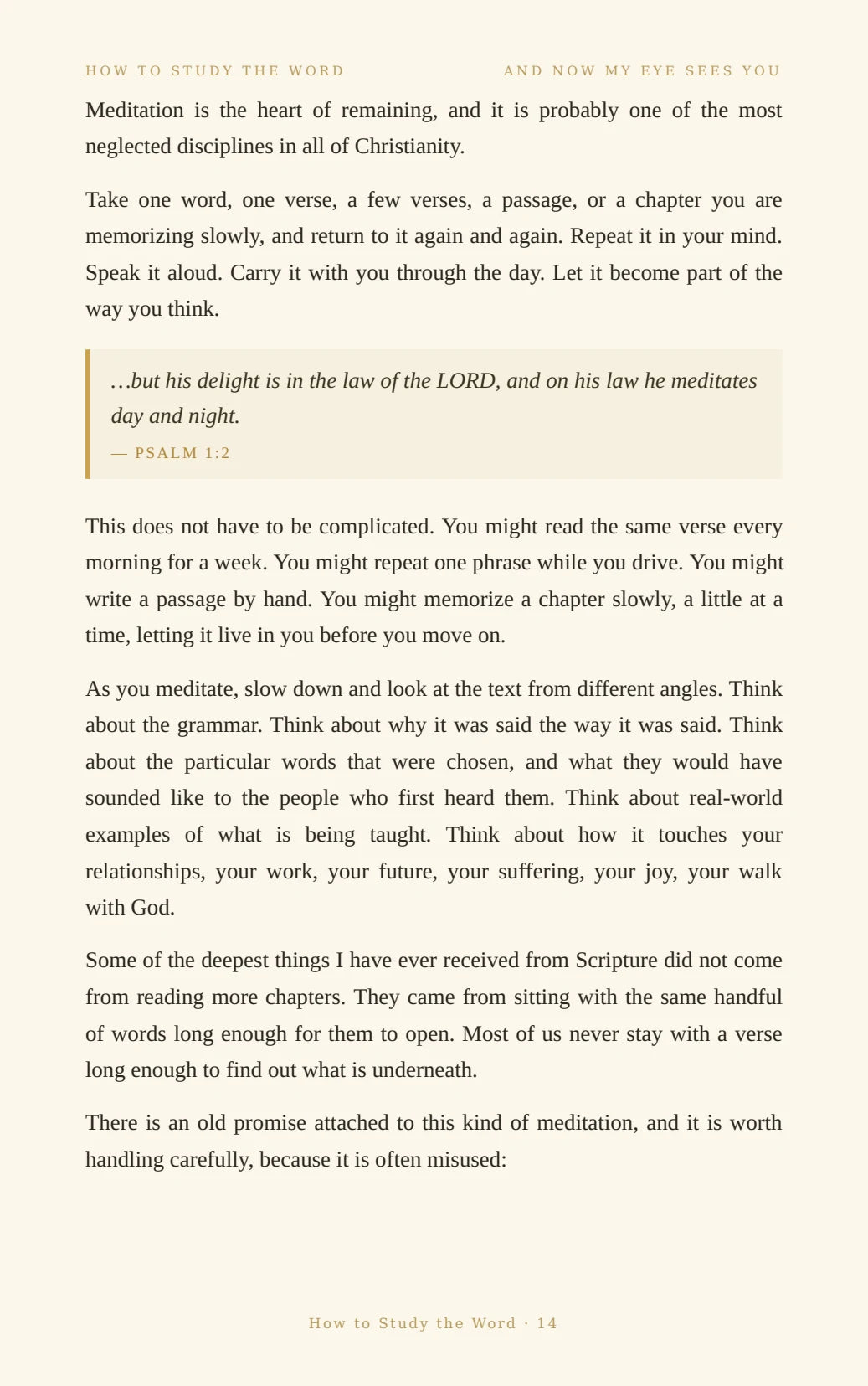
Read, repeat, meditate, and stay with the words long enough to notice what you normally read past.
Carry a simple, repeatable path into Scripture without turning study into a checklist.
Use free tools to look behind an English word without already knowing the biblical languages.
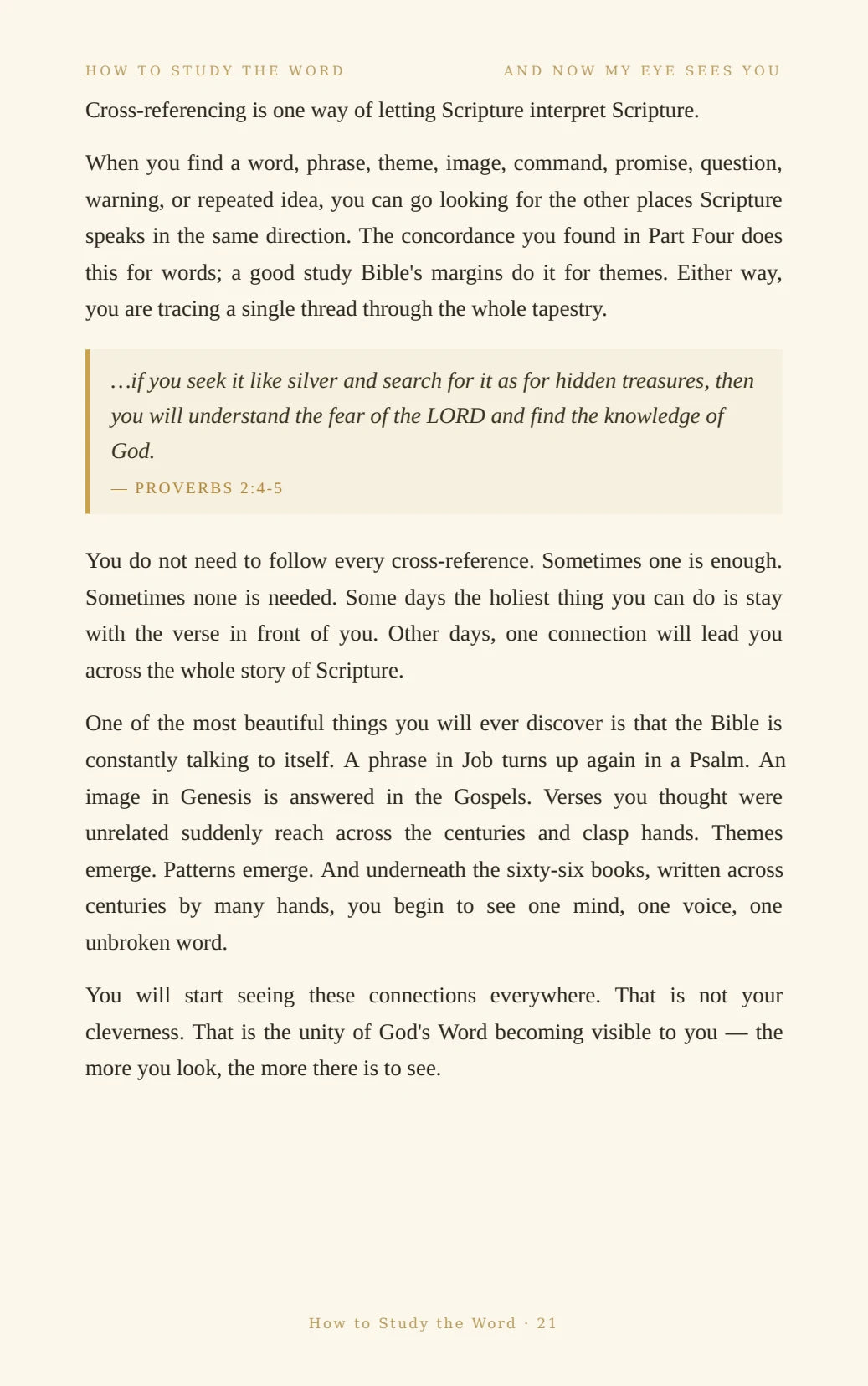
Follow one or two cross-references and trace a thread through the larger biblical witness.
Come back from research to the passage itself, then pray, obey, and build your life around what matters most.
A LOOK INSIDE
A beautiful, practical guide with a clear method, careful counsel, and a printable LINGER practice page.
Swipe on touch screens, or focus the gallery and use the arrow keys.
HEBREW AND GREEK
The guide shows you how to use free tools such as Blue Letter Bible or BibleHub to look behind an English word, see its range of meaning, and then return to the verse.
You are not correcting the translation or becoming an expert by finding a Strong’s number. Original-language study is a servant of Scripture: one way to notice texture, repetition, and connections the English may not fully carry.
A word may have a wide range, but the whole range does not automatically apply every time it appears.
A word’s history can add color, but the root is not always the meaning in a particular verse.
Once you have seen the range of meaning, return to the verse, pray through it, and let it land.
When good resources identify uncertainty or disagreement, hold the connection lightly and resist overstating it.
THE BIGGER PICTURE
Prayer, meditation, cross-references, word study, and repetition are not the final prize. They are ways of drawing nearer to God, knowing Christ, becoming rooted in His Word, and increasingly seeing life in His light.
There is no rush. There is no finish line you are failing to reach. There is only more of Him, always, waiting to be found.
BEGIN HERE
You do not need to become an expert overnight. Begin with one passage, one focus, and enough time to remain.
One passage → one focus → enough time to remain
Enter your first name, email address, and mobile number to receive the free 29-page guide.
A FEW QUESTIONS
Yes. It is a free digital companion guide from The Bible Study Library.
It is for everyday believers who want to move beyond simply reading and begin engaging Scripture more slowly, prayerfully, and attentively.
No. The guide introduces free tools that can help you begin exploring original words without already reading the biblical languages.
No. The movements are available practices, not boxes that must be checked every time. Some days one movement may be enough.
A downloadable 29-page PDF.
After you submit your first name, email address, and mobile number, Shopify sends you to the download page and the guide-delivery email is triggered.